在一個高度發展的技術領域,一個小小的改善,亦具有進步性。
http://www.tms.org/pubs/journals/jom/matters/matters-9609.html
Crowded Art: This refers to an area of technology in which there have been a large number of prior inventions. In a crowded art, it takes less of an advancement to obtain a valid patent. Otherwise, one would have to conclude that there can be no further patenting in that art.
http://www.dallasbar.com/members/headnotes_showarticle.asp?article_id=1447&issue_id=131
For example, in Gemtron Corp. v. Saint-Gobain Corp., the District Court for the Western District of Michigan denied summary judgment and found that “KSR does not automatically call for a ruling of invalidity unless the patent challenged is a major development in the art” because even “narrow improvements in a crowded art” continue to be patentable.
12/15/2010


9/04/2010
請求項的範圍能夠包含不可操作的實施例。
http://www.patent-tutorial.net/content/forum/1880
claim的範圍是可以包含inoperative的實施例。
"From the point of view of patent laws, there is no requirement that the entire range covered by a claim must be operable. As long as a reasonable range that is covered by a claim is operable, the claim complies with the requierment of the law."
Moreover, where a patent discloses several alternative combinations of methods (as most systems claims will), the party asserting inoperability must show that all disclosed alternatives are inoperative or not enabled. EMI Group, 268 F.3d at 1349. The '532 and '123 patents do not claim an impossible result or an inoperative invention.
2164.08(b) Inoperative Subject Matter
The presence of inoperative embodiments within the scope of a claim does not necessarily render a claim nonenabled. The standard is whether a skilled person could determine which embodiments that were conceived, but not yet made, would be inoperative or operative with expenditure of no more effort than is normally required in the art. Atlas Powder Co. v. E.I. du Pont de Nemours & Co., 750 F.2d 1569, 1577, 224 USPQ 409, 414 (Fed. Cir. 1984) (prophetic examples do not make the disclosure nonenabling).
請求項的範圍中包含有不可操作的實施例,不必然會使請求項為無法致能。其標準在於:該行業者是否能夠判斷,於該領域中僅僅儘平常所需之努力的情況下,哪些實施例會被認為無法操作或可操作。
「with expenditure of no more effort than is normally required in the art.」這一句還真難翻譯。不懂得改成這樣會不會比較看得懂?算不算對?「with expenditure of effort which(expenditure) is no more than normally required in the art.」
claim的範圍是可以包含inoperative的實施例。
"From the point of view of patent laws, there is no requirement that the entire range covered by a claim must be operable. As long as a reasonable range that is covered by a claim is operable, the claim complies with the requierment of the law."
Moreover, where a patent discloses several alternative combinations of methods (as most systems claims will), the party asserting inoperability must show that all disclosed alternatives are inoperative or not enabled. EMI Group, 268 F.3d at 1349. The '532 and '123 patents do not claim an impossible result or an inoperative invention.
2164.08(b) Inoperative Subject Matter
The presence of inoperative embodiments within the scope of a claim does not necessarily render a claim nonenabled. The standard is whether a skilled person could determine which embodiments that were conceived, but not yet made, would be inoperative or operative with expenditure of no more effort than is normally required in the art. Atlas Powder Co. v. E.I. du Pont de Nemours & Co., 750 F.2d 1569, 1577, 224 USPQ 409, 414 (Fed. Cir. 1984) (prophetic examples do not make the disclosure nonenabling).
請求項的範圍中包含有不可操作的實施例,不必然會使請求項為無法致能。其標準在於:該行業者是否能夠判斷,於該領域中僅僅儘平常所需之努力的情況下,哪些實施例會被認為無法操作或可操作。
「with expenditure of no more effort than is normally required in the art.」這一句還真難翻譯。不懂得改成這樣會不會比較看得懂?算不算對?「with expenditure of effort which(expenditure) is no more than normally required in the art.」
3/24/2008
進步性的答辯方向(二)
進步性的答辯方向(二)
此連結(the patent prospector)中亦列出了將來能夠用來進行進步性答辯的方向。
1、請求項源自不可預期的效果。當指出先前技藝方式無法產生相似的效果時,這是最佳的使用時機。
2、先前技藝所使用之被展現的特性,相異於所請求之發明所達成的特性。此可視為不可預期之效果的變化。
3、所舉出之先前技藝,對所請求之發明提供相反教示。當先前技術所採用之技術方向,係達成相異的結果;使用相異的手段或相異的程序時,這是最佳的使用時機。
4、所舉出之先前技藝的組合,產生相異的效果,因此不會產生所請求的發明。
5、當證據顯示,所舉出之先前技藝的組合係以某種方式相異於所請求的發明時,可以爭論,所請求的發明並非一種組合。
6、審查員適用了後見之明的偏見,因為所請求之發明其所欲解決的問題,係利用先前技術以相異的文脈來看待,並且從該(先前技術的)文脈來看,此解決方案不會被視為顯而易知的。替代地(Alternately),於先前技藝的架構中,所述之組合不會被認為是一種合理可預想的成功組合。當相反教示的爭論不能被證實時,這比較是一種微妙的變化型。
7、組合是源自相差很大的技術領域,而先前技藝的應用實質上相異於所請求發明,因此,此組合僅能由後見之明所思及。
8、所舉出之先前技藝係組合不同的程序,此些程序發生於不同的文脈,使用不同的機制,處於不同的階段,及/或具有不同的效果。
9、所請求之元件其一的功能相異於所舉出之先前技藝。
10、於先前技藝具有無限的組合可能,且一種特殊的,先前未被知道的洞察結果,導出所請求的發明。
11、審查員並未提供理由或分析為何參考文獻會被組合。唉,這對審查員是一種愚弄,他會以捏造的理由反擊,而攻擊這不切實際的理由希望渺茫,不過,承受所有你能承受的打擊。
12、所組合的參考文獻未教示請求項所有的限制條件。
13、所提案之組合或修改,會破壞參考文獻的功能,或使其無法滿足它的使用目的(參考MPEP 2143.01)。
14、所請求之範圍的重要性;加上產生該效果的證據(參考MPEP 2144.05)。
15、二次考量,如商業的成功(祝好運)、滿足長期的需求、其他人的失敗、被其他人複製。
16、不將參考文獻加以組合係為常識,因此所請求之發明非顯而易知。換言之,將參考文獻加以組合為非常識。有一點像在反駁整體的置換可能性。
==========
From that flow possible arguments to counter obviousness. There are but a few primary thrusts, with variations that apply to different claimed subject matter.
1) The claims derive from unpredictable results. Best used when pointing out how the prior art approach failed to yield similar results.
2) The prior art use exhibited different properties than that achieved by the claimed invention; a variation of unpredictable results.
3) The cited prior art teaches away from the claimed invention. Best used when the prior art takes a vector that achieves different results, uses different means or different process.
4) The cited prior art combination yielded different results, so would not yield the claimed invention.
5) The claimed invention is not a combination, as evidence by the cited combination prior art being different in some way from the claimed invention.
6) Hindsight bias was applied by the examiner because the problem solved by the claimed invention was viewed in a different context by the cited prior art; from that (prior art) context, the solution would thus not have been obvious. Alternately, in the framework of prior art application, the cited combination would not have been considered to have a reasonable expectation of success. This a more subtle variant when the teaching away argument cannot be substantiated.
7) The combination results from such disparate technology arts, where prior art application was substantially different than claimed, that the combination could only be conceived in hindsight.
8) The cited prior art combines different processes occurring in different contexts, using different mechanisms, at different stages, and/or with different results.
9) One of the claimed elements functions differently than in the cited prior art.
10) There were an infinite number of combinations possible in the prior art, and a particular previously unrealized insight led to the claimed invention.
11) The examiner did not provide a reason or analysis of why references would be combined. Alas, this is mostly a taunt for the examiner to come back with a cooked-up rationale. Attacking the rationale as unrealistic may be a long shot, but take all the shots you can get.
I've been trying to come up with a list of possible attacks on prima facie obviousness, since the KSR decision came down. Your list is helpful, but pitiful (unfortunately, this is what we're left with).
I would add the following:
1. Combined references fail to teach all claim limitations--we've still got this one, lest we forget.
MPEP 2143.01
2. The proposed combination or modification would destroy the functioning of the reference, or make it unsatisfactory for its intended purpose.
MPEP 2144.05
3. Criticality of claimed ranges + evidence to that effect.
Secondary Factors
1. Commercial success (good luck)
2. Satisfaction of long felt need
3. Failure of others
4. Copying by others
IMO, KSR sort of revived the secondary considerations as a point of attack. By citing them favorably, I think the SCOTUS may force the PTO to pay more than lip service when denying patentability over these. However, obviously, more than argument will be necessary to establish their validity.
Hawk anb BierBelly,
Love your posts, here and otherwise.
If my memory serves, and it doesn't always anymore due to my advancing years, there was a Fed. Cir. decision, maybe a little after KSR, and non-precedential, in which the court found the invention non-obvious because it would have been common sense NOT to combine the references, or in other words, that it would have been uncommon sense to combine the references.
I think the case involved a situation where reference A had an element for performing a particular function and the court said there was nothing, including common sense, that would provide one of ordinary skill in the art with a reason to swap that element with another, different element from reference B for performing the same function. Kind of cutting against that whole "interchangeability" reasoning for combining.
I'll keep your lists in mind, but what I've found since KSR is that it's just easier to make a technical argument. Explain why the proposed modification or combination just wouldn't be done, wouldn't make sense, wouldn't be beneficial.
2/04/2008
Doctrine of Full Scope Enablement 致能整個請求範圍
CAFC Continues to Expand Doctrine of Full Scope Enablement
When analyzing enablement, the court looks to ensure that the “full scope of the invention” is enabled — and thus looking beyond whether the particular accused design is enabled.
對致能要件進行分析時,法院在確認特定之被控侵權設計是否“被致能”前,應先確認整個發明的範圍是否被致能。
However, the “full scope” doctrine has serious deficiencies. The most notable are the potentially chaotic results from applying the doctrine to claims that include the comprising transition language. The problem arises because the comprising transition allows a claim implicitly encompass a wide variety of add on limitations that might be found in an infringing device. See, for example Automotive Technologies Int’l v. BMW (Fed. Cir. 2007) (claim scope that implicitly covered both mechanical and electrical sensor was not enabled by description of mechanical sensor); Liebel-Flarsheim v. Medrad (Fed. Cir. 2007) (claim scope that implicitly covered both jacketed and jacket-free needle holders was not enabled by description of jacketed needle holders).
最值得注意的是,將此條原則(Doctrine of Full Scope Enablement)應用於包含開放式連接詞comprising的請求項時,會導致潛在的混亂。此問題的產生原因在於,開放式連接詞允許請求項暗示地包含各種多樣的附加限制條件,而能夠於侵權物中找到該些限制條件。
心得:
- 在寫說明書時,應該小心使用comprising.
- 專利權人在進行解譯申請專利範圍時,應該小心解譯後的“整個”權利範圍,是否能被說明書所支持。
- 強化附屬項,即多寫幾個看似無用的附屬項。 例如,於Automotive Technologies Int’l v. BMW 一案中,獨立項寫sensor附屬項寫mechanical sensor。看到這種判例,才會覺得附屬項的重要性。
=========================
http://www.agc.co.jp/news/2002/0401.html
"Look Beyond"には、グループのスローガンとして、「将来を見据え」「自らの領域を超えた視点を持ち」「現状に満足せず飽くなき革新を追求する」などの意味が込められています。
http://eow.alc.co.jp/look%20beyond/UTF-8/
look beyond
~の先を思い描く(在想…之前,先……。)
・Try to look beyond the 21st century. : 21世紀より先を思い描いてごらん。
is enabled 被致能
這個詞真的很難翻譯,翻長一點會比較通順一點,即「說明書的揭露是否能夠使此行業者能夠具以實施」,此行業者是學習日文的「当業者」更正確的用語為「於此領域具有通常知識者」。
專利這行業要求用語使用正確又精簡,難!
12/06/2007
11/13/2007
進步性
CAFC於此案例中澄清顯而易知性拒絕理由的基本規則。
The CAFC (04-1616) in this case further clarified the ground rules for obviousness rejection.
Board
Bord 認為發明之使用目的不足以支持可專利性,其指出「所請求裝置其被意圖之使用的方式,不足以區別出“所請求裝置”與”滿足所請求裝置之限制條件的先前技術”間的差異」
First, the Board rejected the argument that the invention’s intended use supports patentability, noting that “the manner in which a claimed apparatus is intended to be employed does not differentiate the claimed apparatus [from] a prior art apparatus satisfying the claimed structural limitations.” Id. at 5-6. Second, the Board rejected the argument that because “the purposes of the [prior art] references . . . are different from the [invention’s] purpose,” the invention is non-obvious, explaining that “[t]he law . . . does not require that references be combined for reasons contemplated by an inventor” and that “prior art need not suggest the same problem set forth by appellant.”
CAFC
要考慮顯而易知性分析的動機時,所審查之欲解決的問題並不特定於本發明所欲解決的問題,而是在創作本發明前發明人所遇到的一般性問題。
此句話的意思是,作為表面初步證據的引證案,其說明書中所提及之所欲解決的問題,即使不相同於本發明,亦為適格的表面初步證據。
In considering motivation in the obviousness analysis, the problem examined is not the specific problem solved by the invention but the general problem that confronted the inventor before the invention was made. See, e.g., Cross Med. Prods., Inc. v. Medtronic Sofamor Danek, Inc., 424 F.3d 1293, 1323 (Fed. Cir. 2005) (“One of ordinary skill in the art need not see the identical problem addressed in a prior art reference to be motivated to apply its teachings.”); Ecolochem, Inc. v. S. Cal. Edison Co., 227 F.3d 1361, 1372 (Fed. Cir. 2000) (“Although the suggestion to combine references may flow from the nature of the problem, ‘[d]efining the problem in terms of its solution reveals improper hindsight in the selection of the prior art relevant to obviousness.’” (internal citation omitted) (quoting Monarch Knitting Mach. Corp. v. Sulzer Morat GmbH, 139 F.3d 877, 881 (Fed. Cir. 1998))); In re Beattie, 974 F.2d 1309, 1312 (Fed. Cir. 1992) (“[T]he law does not require that the references be combined for the reasons contemplated by the inventor.”); Princeton Biochemicals, Inc. v. Beckman Coulter, Inc., 411 F.3d 1332, 1337 (Fed. Cir. 2005) (characterizing the relevant inquiry as “[would] an artisan of ordinary skill in the art at the time of the invention, confronted by the same problems as the inventor and with no knowledge of the claimed invention,[] have selected the various elements from the prior art and combined them in the manner claimed”); see also Graham, 383 U.S. at 35 (characterizing the problem as involving mechanical closures rather than in terms more specific to the patent in the context of determining the pertinent prior art). Therefore, the “motivation-suggestion-teaching” test asks not merely what the references disclose, but whether a person of ordinary skill in the art, possessed with the understandings and knowledge reflected in the prior art, and motivated by the general problem facing the inventor, would have been led to make the combination recited in the claims. See Cross Med. Prods., 424 F.3d at 1321-24. From this it may be determined whether the overall disclosures, teachings, and suggestions of the prior art, and the level of skill in the art—i.e., the understandings and knowledge of persons having ordinary skill in the art at the time of the invention—support the legal conclusion of obviousness. See Princeton Biochemicals, 411 F.3d at 1338 (pointing to evidence supplying detailed analysis of the prior art and the reasons one of ordinary skill would have possessed the knowledge and motivation to combine).
==================
intended use, is intended to be employed 使用目的
2/08/2007
可專利性分析及侵權分析
可專利性分析及侵權分析
最近因為某些原因,開啟了我想整理“可專利性分析及侵權分析”之間的關聯,以下僅是初步的整理,以及我所找到的相關判決,等到讀得不較熟了之後,再重新整理一次。
自己做過的整理
http://patentdic.blogspot.com/2005/06/blog-post_18.html
http://patentdic.blogspot.com/2005/07/blog-post_19.html
http://www.tms.org/pubs/journals/JOM/matters/matters-9609.html
一個美國專利律師自製的專利字典
That Which Infringes if Later, Anticipates if Earlier: A rule stating the equivalence between two tests under patent law (i.e., the test of infringement of a patent and the test of anticipation in the prior art to invalidate a patent). If the claim of a patent is literally infringed by a prior art reference, then the claim is anticipated by that prior art reference and, therefore, is unpatentable. Note that there cannot be anticipation of a claim by equivalents.
幾則舊判例:
Lindemann Maschinenfabrik GMBH v. American Hoist & Derrick Co. (Fed. Cir. 1984)
SSIH Equip. S.A. v. United States Int'l Trade Comm'n (Fed. Cir. 1983)
Lewmar Marine, Inc. v. Barient, Inc. (Fed. Cir. 1987)
關於以侵權角度來判斷是否具新穎性,請參考以下連結:
http://patentdic.blogspot.com/2005/06/blog-post_18.html
以上連結是我於2005年6月13日所做的blog,請您們參考,其中請特別注意下面幾段文字:A century-old axiom of patent law holds that a product "which would literally infringe if later in time anticipates if earlier."
最早出現以侵權角度來判斷是否具新穎性的判例,應該是這一個:accord Peters v. Active Mfg. Co., 129 U.S. 530, 537 (1889) ("That which infringes, if later, would anticipate, if earlier.").
其他以侵權角度來判斷"雙重專利"的判例,請參考以下連結:
http://patentdic.blogspot.com/2005/07/blog-post_19.html
還有請參照附件(amendment2003.pdf),於其內第12頁,撰寫到:
The test currently used for same invention-type double patenting is "whether one of the claims being compared could be literally infringed without literally infringing the other. If it could be, the claims do not define identically the same invention." In re Vogel, 422 F.2d 438, 441 (C.C.P.A. 1970).
事實上,除了以侵權角度來看申請時的可專利性判斷,如新穎性及雙重專利,其他還有以“進步性”的判斷來測試是否具“均等侵權”的學說,其大意為:若疑似侵權物若相對於被侵權專利,具有可專利性(進步性)時,該疑似侵權物,就不會落入被侵權專利的“均等範圍”。
原因在於,具進步性一定要是非“insubstantial differences(or insubstantial change)”,而均等範圍具一定要是“insubstantial differences”。
請參考附件(Intellectual propert_Patent Law Course Materials.pdf),第420頁。
If the accused infringer has received a patent on the product or process accused of infringing, should that affect the doctrine of equivalents analysis?
Evidence of a patent covering the change, in my view, is clearly relevant unless the patent is invalid. A substitution in a patented invention cannot be both nonobvious and insubstantial. I would apply nonobviousness as the test for the "insubstantial change" requirement of Hilton Davis.
所以侵權分析的概念,不見得一定不同於可專利性分析。不過,我也覺得它們其實是不相同的概念,因為侵權分析一定是“製品”和“文字”間的比對;但是可專利性(新穎性)分析卻常常是“文字”和“文字”的比對,最大的不同在於文字可以有範圍,而製品則沒有。例如,文字可以用“金屬”來表示範圍,但在製品時只能用某一種金屬來製造,只有元件沒有範圍。
1893年,美國最高法院的判例
U.S. Supreme Court
KNAPP v. MORSS, 150 U.S. 221 (1893)
http://ides13.googlepages.com/1893.doc
they would constitute an infringement thereof, for the rule is well established 'that which infringes, if later, would anticipate, if earlier.'
最近因為某些原因,開啟了我想整理“可專利性分析及侵權分析”之間的關聯,以下僅是初步的整理,以及我所找到的相關判決,等到讀得不較熟了之後,再重新整理一次。
自己做過的整理
http://patentdic.blogspot.com/2005/06/blog-post_18.html
http://patentdic.blogspot.com/2005/07/blog-post_19.html
http://www.tms.org/pubs/journals/JOM/matters/matters-9609.html
一個美國專利律師自製的專利字典
That Which Infringes if Later, Anticipates if Earlier: A rule stating the equivalence between two tests under patent law (i.e., the test of infringement of a patent and the test of anticipation in the prior art to invalidate a patent). If the claim of a patent is literally infringed by a prior art reference, then the claim is anticipated by that prior art reference and, therefore, is unpatentable. Note that there cannot be anticipation of a claim by equivalents.
幾則舊判例:
Lindemann Maschinenfabrik GMBH v. American Hoist & Derrick Co. (Fed. Cir. 1984)
SSIH Equip. S.A. v. United States Int'l Trade Comm'n (Fed. Cir. 1983)
Lewmar Marine, Inc. v. Barient, Inc. (Fed. Cir. 1987)
關於以侵權角度來判斷是否具新穎性,請參考以下連結:
http://patentdic.blogspot.com/2005/06/blog-post_18.html
以上連結是我於2005年6月13日所做的blog,請您們參考,其中請特別注意下面幾段文字:A century-old axiom of patent law holds that a product "which would literally infringe if later in time anticipates if earlier."
最早出現以侵權角度來判斷是否具新穎性的判例,應該是這一個:accord Peters v. Active Mfg. Co., 129 U.S. 530, 537 (1889) ("That which infringes, if later, would anticipate, if earlier.").
其他以侵權角度來判斷"雙重專利"的判例,請參考以下連結:
http://patentdic.blogspot.com/2005/07/blog-post_19.html
還有請參照附件(amendment2003.pdf),於其內第12頁,撰寫到:
The test currently used for same invention-type double patenting is "whether one of the claims being compared could be literally infringed without literally infringing the other. If it could be, the claims do not define identically the same invention." In re Vogel, 422 F.2d 438, 441 (C.C.P.A. 1970).
事實上,除了以侵權角度來看申請時的可專利性判斷,如新穎性及雙重專利,其他還有以“進步性”的判斷來測試是否具“均等侵權”的學說,其大意為:若疑似侵權物若相對於被侵權專利,具有可專利性(進步性)時,該疑似侵權物,就不會落入被侵權專利的“均等範圍”。
原因在於,具進步性一定要是非“insubstantial differences(or insubstantial change)”,而均等範圍具一定要是“insubstantial differences”。
請參考附件(Intellectual propert_Patent Law Course Materials.pdf),第420頁。
If the accused infringer has received a patent on the product or process accused of infringing, should that affect the doctrine of equivalents analysis?
Evidence of a patent covering the change, in my view, is clearly relevant unless the patent is invalid. A substitution in a patented invention cannot be both nonobvious and insubstantial. I would apply nonobviousness as the test for the "insubstantial change" requirement of Hilton Davis.
所以侵權分析的概念,不見得一定不同於可專利性分析。不過,我也覺得它們其實是不相同的概念,因為侵權分析一定是“製品”和“文字”間的比對;但是可專利性(新穎性)分析卻常常是“文字”和“文字”的比對,最大的不同在於文字可以有範圍,而製品則沒有。例如,文字可以用“金屬”來表示範圍,但在製品時只能用某一種金屬來製造,只有元件沒有範圍。
1893年,美國最高法院的判例
U.S. Supreme Court
KNAPP v. MORSS, 150 U.S. 221 (1893)
http://ides13.googlepages.com/1893.doc
they would constitute an infringement thereof, for the rule is well established 'that which infringes, if later, would anticipate, if earlier.'
9/18/2005
你的專利有用嗎?
你的專利有用嗎?
這是一篇探討“實用性”的文章:
To obtain a patent, an invention must be useful. An inherently inoperative invention lacks the necessary utility, and thus is not entitled to a patent.(沒有“產業利用性”的話是不能得到專利)
Ms. Cortright有個治療禿頭的發明,被審查委員以不具“實用性”核駁,原因滿有趣的:Specifically, the Patent Office presumed that her baldness treatment claims were suspect because baldness is generally considered“incurable”。禿頭真的是incurable的嗎?還好我沒有這種困擾。最後PTO因Ms. Cortright 缺乏臨床實驗證據(had failed to present any clinical evidence)而核駁該專利。
On appeal, the Board of Patent Appeals and Interferences (an appeal board within the Patent Office) clarified that Ms. Cortright was not required to submit clinical evidence of Bag Balm�s� effectiveness to establish her invention�s utility. All that patent law requires for the purpose of establishing utility is a credible assertion, as assessed from an ordinarily skilled professional�s perspective, that the invention works for its intended purpose.
Board則認為要實用性的不需要臨床實驗證據,僅需要“credible assertion”。但卻以不符合enablement拒絕Ms. Cortright的專利。
Reviewing other patents for baldness treatment, the Court concluded that a claim for restoring hair growth was not a promise of a full head of hair.(治禿頭的發明也不需要a promise of a full head of hair,有長就好)
As this case illustrates, the utility requirement is a relatively easy requirement to meet. You must show only that your invention is capable of performing some beneficial function to humanity, which may be not much if only marginal benefit is expected in the particular field of technology.
我覺得重點在“capable of performing some beneficial function to humanity, which may be not much if only marginal benefit is expected”,實用性的要求是滿低的標準對吧,不過我現在才知道。
最後,摘錄一段很有趣的句子:
Do you think the panel’s ruling in this case was affected by the fact that each judge (Chief Judge Mayer, and Circuit Judges Newman and Rader) has a full head of hair?
這是一篇探討“實用性”的文章:
To obtain a patent, an invention must be useful. An inherently inoperative invention lacks the necessary utility, and thus is not entitled to a patent.(沒有“產業利用性”的話是不能得到專利)
Ms. Cortright有個治療禿頭的發明,被審查委員以不具“實用性”核駁,原因滿有趣的:Specifically, the Patent Office presumed that her baldness treatment claims were suspect because baldness is generally considered“incurable”。禿頭真的是incurable的嗎?還好我沒有這種困擾。最後PTO因Ms. Cortright 缺乏臨床實驗證據(had failed to present any clinical evidence)而核駁該專利。
On appeal, the Board of Patent Appeals and Interferences (an appeal board within the Patent Office) clarified that Ms. Cortright was not required to submit clinical evidence of Bag Balm�s� effectiveness to establish her invention�s utility. All that patent law requires for the purpose of establishing utility is a credible assertion, as assessed from an ordinarily skilled professional�s perspective, that the invention works for its intended purpose.
Board則認為要實用性的不需要臨床實驗證據,僅需要“credible assertion”。但卻以不符合enablement拒絕Ms. Cortright的專利。
Reviewing other patents for baldness treatment, the Court concluded that a claim for restoring hair growth was not a promise of a full head of hair.(治禿頭的發明也不需要a promise of a full head of hair,有長就好)
As this case illustrates, the utility requirement is a relatively easy requirement to meet. You must show only that your invention is capable of performing some beneficial function to humanity, which may be not much if only marginal benefit is expected in the particular field of technology.
我覺得重點在“capable of performing some beneficial function to humanity, which may be not much if only marginal benefit is expected”,實用性的要求是滿低的標準對吧,不過我現在才知道。
最後,摘錄一段很有趣的句子:
Do you think the panel’s ruling in this case was affected by the fact that each judge (Chief Judge Mayer, and Circuit Judges Newman and Rader) has a full head of hair?
7/06/2005
【筆記】102(a)及102(b)的競合
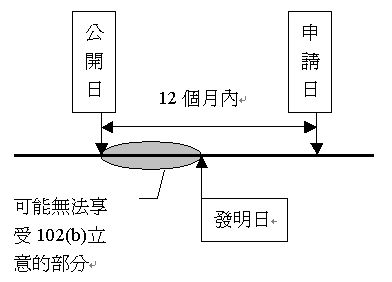
(a) the invention was known or used by others in this country, or patented or described in a printed publication in this or a foreign country(沒有“another”,makes no reference to "another" in the context of authorship of a publication), before the invention thereof by the applicant for patent.
試想若某發明人在刊物上公開''a",於日後將其改良而發明“A”再拿“A”來申請專利,在102(a)沒有限定“another”的情況下,"a"的公開會造成"A"的阻卻事由嗎?
參見“In re Davia Harvey Katz”:
It may not be readily apparent from the statutory language that a printed publication cannot stand as a reference under § 102(a) unless it is describing the work of another. A literal reading might appear to make a prior patent or printed publication "prior art" even though the disclosure is that of the applicant's own work. However, such an interpretation of this section of the statute would negate the one year period afforded under § 102(b) n1 during which an inventor is allowed to perfect, develop and apply for a patent on his invention and publish descriptions of it if he wishes.
As stated by this court in In re Facius, 56 CCPA 1348, 1358 , 408 F.2d 1396, 1406, 161 USPQ 294, 302 (1969), "But certainly one's own invention, whatever the form of disclosure to the public, may not be prior art against oneself, absent a statutory bar."
102(a)並沒有特別限定刊物的作者,因此可以解譯成“自己”或“別人”的作品都可作為prior art,但是若解譯成“自己”的也可以作為prior art的話,申請人就無法享受到102(b)的立法意旨。因此"But certainly one's own invention, whatever the form of disclosure to the public, may not be prior art against oneself, absent a statutory bar."。也就是說,發明人自己的作品若是在102(b)所提供之12個月的優惠期內,不應被當作prior art。
=================================
MPEP內的相關資訊
III. “BY OTHERS”
“Others” Means Any Combination of Authors or Inventors Different Than the Inventive Entity
The term “others” in 35 U.S.C. 102(a) refers to any entity which is different from the inventive entity. The entity need only differ by one person to be “by others.”
This holds true for all types of references eligible as prior art under 35 U.S.C. 102(a) including publications as well as public knowledge and use. Any other interpretation of 35 U.S.C. 102(a) “would negate the one year [grace] period afforded under § 102(b).” In re Katz, 687 F.2d 450, 215 USPQ 14 (CCPA 1982).
7/05/2005
【102】美專102(e)的整理
此篇僅整理2000年11月29日以後的部分,更早之前的部分請自行參照 MPEP。
A person shall be entitled to a patent unless
(e)the invention was described in —
(1) an application for patent, published under section 122(b), by another filed in the United States before the invention by the applicant for patent or
(2) a patent granted on an application for patent by another filed in the United States before the invention by the applicant for patent,
[(3)]except that an international application filed under the treaty defined in section 351(a) shall have the effects for the purposes of this subsection of an application filed in the United States only if the international application designated the United States and was published under Article 21(2) of such treaty in the English language.
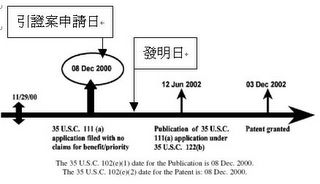
●引證案於12 June 2002號公開,符合 35 U.S.C. 102(e)(1) 的規定,故引證案的“Critical Reference Date”為它在美國的有效申請日 08 Dec. 2000。
●引證案於03 Dec 2002號獲准專利,符合 35 U.S.C. 102(e)(2) 的規定,故引證案的“Critical Reference Date”為它在美國的有效申請日 08 Dec. 2000。
●會將102(e)分成(1)及(2)的原因是:在美國並在某些條件下申請人可以決定是否要早期公開。
● 請留意“但書”的部分,PCT的申請案符合“designated the United States”、“published under Article 21(2)”、“in the English”的話,PCT的申請日亦可作為102(e)的“Critical Reference Date”。
要了解102(e),應先從如何建立美國專利案或美國專利申請案的“Critical Reference Date”,請自行參照 MPEP 706.02(f)(1) 的部分,此文章中僅列出較容易造成誤解的地方:
(1) 主張國外優先權的申請案,其國際優先權日不能作為102(e)的“prior art date”,它的 102(e) prior art date 日期為它在美國的有效申請日。主張國內優先權的申請案,其國內優先權日可以作為102(e)的“prior art date”。參見以下例2及例3。
(2)PCT申請案的話僅有符合“但書”的部分才可有102(e)的“prior art date”,但是若不符合但書的三個條件如不以英文公開的話,就無法取得任何102(e)的“prior art date”。參見MPEP此部分的例4及例5。
Example 2: Reference Publication and Patent of 35 U.S.C. 111(a) Application with Priority/Benefit Claim to a Prior U.S. Provisional or Nonprovisional Application.
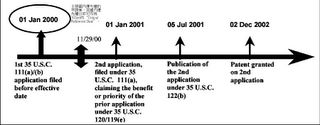
For reference publications and patents of patent applications filed under 35 U.S.C. 111(a), the prior art dates under 35 U.S.C. 102(e) accorded to these references are the earliest effective U.S. filing dates. Thus, a publication and patent of a 35 U.S.C. 111(a) application, which claims priority under 35 U.S.C. 119(e) to a prior U.S. provisional application or claims the benefit under 35 U.S.C. 120 of a prior nonprovisional application, would be accorded the earlier filing date as its prior art date under 35 U.S.C. 102(e), assuming the earlier-filed application has proper support for the subject matter as required by 35 U.S.C. 119(e) or 120.
Example 3: Reference Publication and Patent of 35 U.S.C. 111(a) Application with 35 U.S.C. 119(a)-(d) Benefit Claim to a Prior Foreign Application.
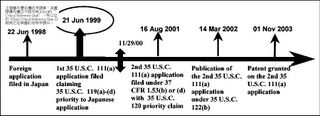
For reference publications and patents of patent applications filed under 35 U.S.C. 111(a), the prior art dates under 35 U.S.C. 102(e) accorded to these references are the earliest effective U.S. filing dates. No benefit of the filing date of the foreign application is given under 35 U.S.C. 102(e) for prior art purposes (In re Hilmer, 149 USPQ 480 (CCPA 1966)).
A person shall be entitled to a patent unless
(e)the invention was described in —
(1) an application for patent, published under section 122(b), by another filed in the United States before the invention by the applicant for patent or
(2) a patent granted on an application for patent by another filed in the United States before the invention by the applicant for patent,
[(3)]except that an international application filed under the treaty defined in section 351(a) shall have the effects for the purposes of this subsection of an application filed in the United States only if the international application designated the United States and was published under Article 21(2) of such treaty in the English language.
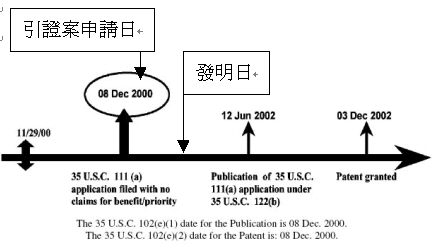
●引證案於12 June 2002號公開,符合 35 U.S.C. 102(e)(1) 的規定,故引證案的“Critical Reference Date”為它在美國的有效申請日 08 Dec. 2000。
●引證案於03 Dec 2002號獲准專利,符合 35 U.S.C. 102(e)(2) 的規定,故引證案的“Critical Reference Date”為它在美國的有效申請日 08 Dec. 2000。
●會將102(e)分成(1)及(2)的原因是:在美國並在某些條件下申請人可以決定是否要早期公開。
● 請留意“但書”的部分,PCT的申請案符合“designated the United States”、“published under Article 21(2)”、“in the English”的話,PCT的申請日亦可作為102(e)的“Critical Reference Date”。
要了解102(e),應先從如何建立美國專利案或美國專利申請案的“Critical Reference Date”,請自行參照 MPEP 706.02(f)(1) 的部分,此文章中僅列出較容易造成誤解的地方:
(1) 主張國外優先權的申請案,其國際優先權日不能作為102(e)的“prior art date”,它的 102(e) prior art date 日期為它在美國的有效申請日。主張國內優先權的申請案,其國內優先權日可以作為102(e)的“prior art date”。參見以下例2及例3。
(2)PCT申請案的話僅有符合“但書”的部分才可有102(e)的“prior art date”,但是若不符合但書的三個條件如不以英文公開的話,就無法取得任何102(e)的“prior art date”。參見MPEP此部分的例4及例5。
Example 2: Reference Publication and Patent of 35 U.S.C. 111(a) Application with Priority/Benefit Claim to a Prior U.S. Provisional or Nonprovisional Application.
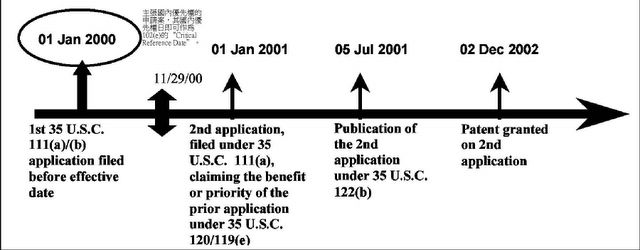
For reference publications and patents of patent applications filed under 35 U.S.C. 111(a), the prior art dates under 35 U.S.C. 102(e) accorded to these references are the earliest effective U.S. filing dates. Thus, a publication and patent of a 35 U.S.C. 111(a) application, which claims priority under 35 U.S.C. 119(e) to a prior U.S. provisional application or claims the benefit under 35 U.S.C. 120 of a prior nonprovisional application, would be accorded the earlier filing date as its prior art date under 35 U.S.C. 102(e), assuming the earlier-filed application has proper support for the subject matter as required by 35 U.S.C. 119(e) or 120.
Example 3: Reference Publication and Patent of 35 U.S.C. 111(a) Application with 35 U.S.C. 119(a)-(d) Benefit Claim to a Prior Foreign Application.

For reference publications and patents of patent applications filed under 35 U.S.C. 111(a), the prior art dates under 35 U.S.C. 102(e) accorded to these references are the earliest effective U.S. filing dates. No benefit of the filing date of the foreign application is given under 35 U.S.C. 102(e) for prior art purposes (In re Hilmer, 149 USPQ 480 (CCPA 1966)).
7/04/2005
【102】美專102(a)的整理
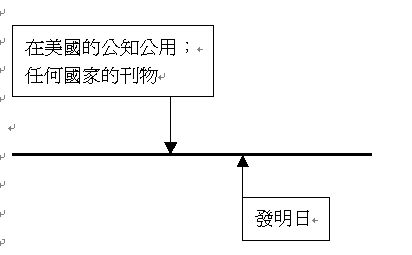
可參考MPEP的2132 35 U.S.C. 102(a):
A person shall be entitled to a patent unless -
(a) the invention was known or used by others in this country,
or patented or described in a printed publication in this or a foreign country, before the invention thereof by the applicant for a patent.
因為102(a)指得是發明日,所以參考文獻若屬於發明人自己的作品,當然不會被用來當作核駁的引證案。
Applicant's disclosure of his or her own work within the year before the application filing date cannot be used against him or her under 35 U.S.C. 102(a). In re Katz, 687 F.2d 450, 215 USPQ 14 (CCPA 1982)
其中要注意的是102(a)中“others”的定義,只要是發明實體(inventive entity)中,有一人不相同則不論增或減,都陂定義為"by others":
The term "others" in 35 U.S.C. 102(a) refers to any entity which is different from the inventive entity. The entity need only differ by one person to be "by others." This holds true for all types of references eligible as prior art under 35 U.S.C. 102(a) including publications as well as public knowledge and use.
故只要inventive entity不同了,即使“swearing back”無法克服inventive entity不同的問題,一樣會落入102(a)的範圍。參考:
A prima facie case is made out under 35 U.S.C. 102(a) if, within 1 year of the filing date, the invention, or an obvious variant thereof, is described in a "printed publication" whose authorship differs in any way from the inventive entity unless it is stated within the publication itself that the publication is describing the applicant's work. In re Katz, 687 F.2d 450, 215 USPQ 14 (CCPA 1982).
雖然inventive entity已經不同了,還是有幾個方法可以補教。
第一個方法叫做“減法”:
Therefore, where the applicant is one of the co-authors of a publication cited against his or her application, the publication may be removed as a reference by the filing of affidavits made out by the other authors establishing that the relevant portions of the publication originated with, or were obtained from, applicant. Such affidavits are called disclaiming affidavits. Ex parte Hirschler, 110 USPQ 384 (Bd. App. 1952).
第二個方法叫做“加法”:
It is also possible to overcome the rejection by adding the coauthors as inventors to the application if the requirements of 35 U.S.C. 116, third paragraph are met. In re Searles, 422 F.2d 431, 164 USPQ 623 (CCPA 1970).
經過加減法使inventive entity相同之後,再“swearing back”,才可以不會再落入102(a)的範圍,但是還是要注意“statutory bar”,小弟將它翻做“法定不予專利事由”。
When the reference is not a statutory bar under 35 U.S.C. 102(b), (c), or (d), applicant can overcome the rejection by swearing back of the reference through the submission of an affidavit under 37 CFR 1.131. In re Foster, 343 F.2d 980, 145 USPQ 166 (CCPA 1965). If the reference is disclosing applicant's own work as derived from him or her, applicant may submit either a 37 CFR 1.131 affidavit to antedate the reference or a 37 CFR 1.132 affidavit to show derivation of the reference subject matter from applicant and invention by applicant. In re Facius, 408 F.2d 1396, 161 USPQ 294 (CCPA 1969).
關於37 CFR 1.131及37 CFR 1.132 affidavit等的部分,以後再做介紹。102(a)的部分還有一個要注意的地方,如果reference是屬於美國專利的話,則應該要考慮102(e):
Note that when the reference is a U.S. patent published within the year prior to the application filing date, a 35 U.S.C. 102(e) rejection should be made. See MPEP § 2136 - § 2136.05 for case law dealing with 102(e).
上面所說的小弟也覺得很奇怪,為何reference是屬於美國專利的話,則一定要以102(e)來核駁,不過我想美專 102是採用負面表列的方式,所以 審查委員可以使用任何一項,若一個reference落入102(a)和102(e)的範圍內,審查委員可以查用任何一條。同樣道理若reference 已經符合102(b)時,就不需要用102(e)來核駁。
6/29/2005
【判例】112與102的enablement要件比較
【判例】112與102的enablement要件比較
http://fedcir.gov/opinions/04-1191.pdf
揭露一發明卻沒有揭露它的用途,還不夠符合美專112的enablement要件。
Rasmusson argues that the Board’s finding regarding efficacy does not support its finding of lack of enablement. According to Rasmusson, efficacy is not relevant to enablement, but pertains only to the issue of utility under 35 U.S.C. § 101.Because the Board did not make a determination based on section 101, Rasmusson asserts that the Board erred.
We disagree. In order to satisfy the enablement requirement of section 112, an applicant must describe the manner of making and using the invention “in such full, clear, concise, and exact terms as to enable any person skilled in the art . . . to make , 992 F.2d 1197, 1200 (Fed. Cir. 1993); see also and use the same . . . .” 35 U.S.C. § 112, para. 1.
如何才算符合美專112的enablement要件
As this court has explained, “the how to use prong of section 112 incorporates as a matter of law the requirement of 35 U.S.C. § 101 that the specification disclose as a matter of fact a practical utility for the invention.” In re Cortright, 165 F.3d 1353, 1356 (Fed. Cir. 1999), quoting In re ZieglerIn re Schoenwald, 964 F.2d 1122, 1124 (Fed. Cir. 1992) (stating that utility must be disclosed to satisfy the section 112 enablement requirement).
In explaining what constitutes a sufficient showing of utility in the context of the enablement requirement, this court has stated that an applicant’s failure to disclose how to use an invention may support a rejection under either section 112, paragraph 1 for lack of enablement, or “section 101 for lack of utility ‘when there is a complete absence of data supporting the statements which set forth the desired results of the claimed invention.’” Cortright, 165 F.3d at 1356, quoting Envirotech Corp. v. Al George, Inc., 730 F.2d 753, 762 (Fed. Cir. 1984).
In the context of determining whether sufficient “utility as a drug, medicant, and the like in human therapy” has been alleged, “it is proper for the examiner to ask for substantiating evidence unless one with ordinary skill in the art would accept the allegations as obviously correct.” In re Jolles, 628 F.2d 1327, 1332 (Fed. Cir. 1980), citing In re Novak, 306 F.2d 924 (CCPA 1962); see Application of Irons, 340 F.2d 974, 977-78 (CCPA 1965).
Indeed, in In re Brana, 51 F.3d 1560 (Fed. Cir. 1995), we stated that “a specification disclosure which contains a teaching of the manner and process of making and using the invention . . . must be taken as in compliance with the enabling requirement of the first paragraph of § 112 unless there is reason to doubt the objective truth of the statements contained therein which must be relied on for enabling support.” , 492 F.2d 859 (CCPA 1974); Application of Hawkins, 486 F.2d 569, 576 (CCPA 1973).
However, where there is “no indication that one skilled in [the] art would accept without question statements [as to the effects of the claimed drug products] and no evidence has been presented to demonstrate that the claimed products do have those effects,” an applicant has failed to demonstrate sufficient utility and therefore cannot establish enablement. Novak, 306 F.2d at 928. Id. at 1566, quoting Marzocchi, 439 F.2d 220, 223 (CCPA 1971); Fiers v. Revel, 984 F.2d 1164, 1171-72 (Fed. Cir. 1993), quoting Marzocchi, 439 F.2d at 223; see also Application of Armbruster, 512 F.2d 676, 677 (CCPA 1975); Application of Knowlton, 500 F.2d 566, 571 (CCPA 1974); Application of Bowen
為什麼“ an applicant has failed to demonstrate sufficient utility”會造成 “ and therefore cannot establish enablement”呢?
Rasmusson argues that the enablement requirement of section 112 does not mandate a showing of utility or, if it does, it mandates only a showing that it is “not implausible” that the invention will work for its intended purpose. As we have explained, we have required a greater measure of proof, and for good reason. If mere plausibility were the test for enablement under section 112, applicants could obtain patent rights to “inventions” consisting of little more than respectable guesses as to the likelihood of their success. When one of the guesses later proved true, the “inventor” would be rewarded the spoils instead of the party who demonstrated that the method actually worked. That scenario is not consistent with the statutory requirement that the inventor enable an invention rather than merely proposing an unproved hypothesis.
=======================================
美專102的enablement要件
A patent claim “cannot be anticipated by a prior art reference if the allegedly anticipatory disclosures cited as prior art are not enabled.” Elan Pharm., Inc. v. Mayo Found. for Med. Educ. & Research, 346 F.3d 1051, 1054 (Fed. Cir. 2003). The standard for what constitutes proper enablement of a prior art reference for purposes of anticipation under section 102, however, differs from the enablement standard under section 112. In In re Hafner, 410 F.2d 1403 (CCPA 1969), the court stated that “a disclosure lacking a teaching of how to use a fully disclosed compound for a specific, substantial utility or of how to use for such purpose a compound produced by a fully disclosed process is, under the present state of the law, entirely adequate to anticipate a claim to either the product or the process and, at the same time, entirely inadequate to support the allowance of such a claim.” Id. at 1405; see Schoenwald, 964 F.2d at 1124; In re Samour, 571 F.2d 559, 563-64 (CCPA 1978).
The reason is that section 112 “provides that the specification must enable one skilled in the art to ‘use’ the invention whereas [section] 102 makes no such requirement as to an anticipatory disclosure.” Hafner, 410 F.2d at 1405; see 1 Donald S. Chisum, Chisum on Patents § 3.04[1][c] (2002); see also In re Cruciferous Sprout Litig., 301 F.3d 1343, 1349-52 (Fed. Cir. 2001) (finding anticipation where applicant sought a patent based on a new use for a previously disclosed method).
Since Hafner, this court has continued to recognize that a prior art reference need not demonstrate utility in order to serve as an anticipating reference under section 102. See Schoenwald, 964 F.2d at 1124 (“it is beyond argument that no utility need be disclosed for a reference to be anticipatory of a claim”); In re Donohue, 632 F.2d 123, 126 n.6 (CCPA 1980) (“proof of utility is not a prerequisite to availability of a prior art reference under 35 U.S.C. § 102(b)”), citing In re Samour, 571 F.2d at 563-64; see also Application of Lukach, 442 F.2d 967, 969 (CCPA 1971) (recognizing that there are “anomalies between the requirements for claim-anticipating disclosures and for claim-supporting disclosures” and citing Hafner as an example).
其他102相關
The court decided that the negative results reported in the article did not prevent the article from anticipating the patent given that “[n]ewly discovered results of known processes directed to the same purpose are not patentable because such results are inherent.”236 F.3d at 1376.
The court explained that “a reference is no less anticipatory if, after disclosing the invention, the reference then disparages it. Thus, the question whether a reference ‘teaches away’ from the invention is inapplicable to an anticipation analysis.” Id. at 1378., quoting Celeritas Techs., Ltd. v. Rockwell Int’l Group, 150 F.3d 1354, 1361 (Fed. Cir. 1998). The court added that “anticipation does not require actual performance of suggestions in a disclosure.” 246 F.3d at 1379.
http://fedcir.gov/opinions/04
揭露一發明卻沒有揭露它的用途,還不夠符合美專112的enablement要件。
Rasmusson argues that the Board’s finding regarding efficacy does not support its finding of lack of enablement. According to Rasmusson, efficacy is not relevant to enablement, but pertains only to the issue of utility under 35 U.S.C. § 101.Because the Board did not make a determination based on section 101, Rasmusson asserts that the Board erred.
We disagree. In order to satisfy the enablement requirement of section 112, an applicant must describe the manner of making and using the invention “in such full, clear, concise, and exact terms as to enable any person skilled in the art . . . to make , 992 F.2d 1197, 1200 (Fed. Cir. 1993); see also and use the same . . . .” 35 U.S.C. § 112, para. 1.
如何才算符合美專112的enablement要件
As this court has explained, “the how to use prong of section 112 incorporates as a matter of law the requirement of 35 U.S.C. § 101 that the specification disclose as a matter of fact a practical utility for the invention.” In re Cortright, 165 F.3d 1353, 1356 (Fed. Cir. 1999), quoting In re ZieglerIn re Schoenwald, 964 F.2d 1122, 1124 (Fed. Cir. 1992) (stating that utility must be disclosed to satisfy the section 112 enablement requirement).
In explaining what constitutes a sufficient showing of utility in the context of the enablement requirement, this court has stated that an applicant’s failure to disclose how to use an invention may support a rejection under either section 112, paragraph 1 for lack of enablement, or “section 101 for lack of utility ‘when there is a complete absence of data supporting the statements which set forth the desired results of the claimed invention.’” Cortright, 165 F.3d at 1356, quoting Envirotech Corp. v. Al George, Inc., 730 F.2d 753, 762 (Fed. Cir. 1984).
In the context of determining whether sufficient “utility as a drug, medicant, and the like in human therapy” has been alleged, “it is proper for the examiner to ask for substantiating evidence unless one with ordinary skill in the art would accept the allegations as obviously correct.” In re Jolles, 628 F.2d 1327, 1332 (Fed. Cir. 1980), citing In re Novak, 306 F.2d 924 (CCPA 1962); see Application of Irons, 340 F.2d 974, 977-78 (CCPA 1965).
Indeed, in In re Brana, 51 F.3d 1560 (Fed. Cir. 1995), we stated that “a specification disclosure which contains a teaching of the manner and process of making and using the invention . . . must be taken as in compliance with the enabling requirement of the first paragraph of § 112 unless there is reason to doubt the objective truth of the statements contained therein which must be relied on for enabling support.” , 492 F.2d 859 (CCPA 1974); Application of Hawkins, 486 F.2d 569, 576 (CCPA 1973).
However, where there is “no indication that one skilled in [the] art would accept without question statements [as to the effects of the claimed drug products] and no evidence has been presented to demonstrate that the claimed products do have those effects,” an applicant has failed to demonstrate sufficient utility and therefore cannot establish enablement. Novak, 306 F.2d at 928. Id. at 1566, quoting Marzocchi, 439 F.2d 220, 223 (CCPA 1971); Fiers v. Revel, 984 F.2d 1164, 1171-72 (Fed. Cir. 1993), quoting Marzocchi, 439 F.2d at 223; see also Application of Armbruster, 512 F.2d 676, 677 (CCPA 1975); Application of Knowlton, 500 F.2d 566, 571 (CCPA 1974); Application of Bowen
為什麼“ an applicant has failed to demonstrate sufficient utility”會造成 “ and therefore cannot establish enablement”呢?
Rasmusson argues that the enablement requirement of section 112 does not mandate a showing of utility or, if it does, it mandates only a showing that it is “not implausible” that the invention will work for its intended purpose. As we have explained, we have required a greater measure of proof, and for good reason. If mere plausibility were the test for enablement under section 112, applicants could obtain patent rights to “inventions” consisting of little more than respectable guesses as to the likelihood of their success. When one of the guesses later proved true, the “inventor” would be rewarded the spoils instead of the party who demonstrated that the method actually worked. That scenario is not consistent with the statutory requirement that the inventor enable an invention rather than merely proposing an unproved hypothesis.
=======================================
美專102的enablement要件
A patent claim “cannot be anticipated by a prior art reference if the allegedly anticipatory disclosures cited as prior art are not enabled.” Elan Pharm., Inc. v. Mayo Found. for Med. Educ. & Research, 346 F.3d 1051, 1054 (Fed. Cir. 2003). The standard for what constitutes proper enablement of a prior art reference for purposes of anticipation under section 102, however, differs from the enablement standard under section 112. In In re Hafner, 410 F.2d 1403 (CCPA 1969), the court stated that “a disclosure lacking a teaching of how to use a fully disclosed compound for a specific, substantial utility or of how to use for such purpose a compound produced by a fully disclosed process is, under the present state of the law, entirely adequate to anticipate a claim to either the product or the process and, at the same time, entirely inadequate to support the allowance of such a claim.” Id. at 1405; see Schoenwald, 964 F.2d at 1124; In re Samour, 571 F.2d 559, 563-64 (CCPA 1978).
The reason is that section 112 “provides that the specification must enable one skilled in the art to ‘use’ the invention whereas [section] 102 makes no such requirement as to an anticipatory disclosure.” Hafner, 410 F.2d at 1405; see 1 Donald S. Chisum, Chisum on Patents § 3.04[1][c] (2002); see also In re Cruciferous Sprout Litig., 301 F.3d 1343, 1349-52 (Fed. Cir. 2001) (finding anticipation where applicant sought a patent based on a new use for a previously disclosed method).
Since Hafner, this court has continued to recognize that a prior art reference need not demonstrate utility in order to serve as an anticipating reference under section 102. See Schoenwald, 964 F.2d at 1124 (“it is beyond argument that no utility need be disclosed for a reference to be anticipatory of a claim”); In re Donohue, 632 F.2d 123, 126 n.6 (CCPA 1980) (“proof of utility is not a prerequisite to availability of a prior art reference under 35 U.S.C. § 102(b)”), citing In re Samour, 571 F.2d at 563-64; see also Application of Lukach, 442 F.2d 967, 969 (CCPA 1971) (recognizing that there are “anomalies between the requirements for claim-anticipating disclosures and for claim-supporting disclosures” and citing Hafner as an example).
其他102相關
The court decided that the negative results reported in the article did not prevent the article from anticipating the patent given that “[n]ewly discovered results of known processes directed to the same purpose are not patentable because such results are inherent.”236 F.3d at 1376.
The court explained that “a reference is no less anticipatory if, after disclosing the invention, the reference then disparages it. Thus, the question whether a reference ‘teaches away’ from the invention is inapplicable to an anticipation analysis.” Id. at 1378., quoting Celeritas Techs., Ltd. v. Rockwell Int’l Group, 150 F.3d 1354, 1361 (Fed. Cir. 1998). The court added that “anticipation does not require actual performance of suggestions in a disclosure.” 246 F.3d at 1379.
6/18/2005
【判例】文字摘錄
http://fedcir.gov/opinions/04-1405.pdf
That which infringes, if later, would anticipate, if earlier.
引證案如果作為後案會侵權本案,則作為前案就會預見本案。
the question whether a reference ‘teaches away’ from the invention is inapplicable to an anticipation analysis.
teaches away不適合用作新穎性的分析。
Upsher-Smith concedes that the European Application contains every element of the asserted claims of the ’624 and ’646 patents except the limitation “essentially free of antioxidants.” Nevertheless, Upsher-Smith argues that because the European Application optionally includes antioxidants the district court erred in finding that it anticipates a limitation that expressly excludes antioxidants.
First, Upsher-Smith argues that the district court erred by placing the burden on Upsher-Smith to prove that the negative limitation was not found in the prior art rather than on Pamlab to prove the presence of the negative limitation in the prior art. The district court did not so err. A century-old axiom of patent law holds that a product “which would literally infringe if later in time anticipates if earlier.” Schering Corp. v. Geneva Pharms., Inc., 339 F.3d 1373, 1379 (Fed. Cir. 2003) (quoting Bristol-Myers Squibb Co. v. Ben Venue Labs., Inc., 246 F.3d 1368, 1378 (Fed. Cir. 2001)); accord Peters v. Active Mfg. Co., 129 U.S. 530, 537 (1889) (“That which infringes, if later, would anticipate, if earlier.”). The European Application’s “optional inclusion” of antioxidants teaches vitamin supplement compositions that both do and do not contain antioxidants. Thus, because compositions made according to the European Application that do not contain antioxidants would infringe the asserted claims of the ’624 and ’646 patents, those compositions anticipate the asserted claims despite no express teaching to exclude the antioxidants in the European Application. Consequently, Pamlab presented a prima facie case of anticipation, and the district court properly placed the burden on Upsher-Smith to present rebuttal evidence sufficient to raise a genuine issue of material fact of no anticipation by the European Application.
In an attempt to rebut Pamlab’s evidence of anticipation, Upsher-Smith argues that the European Application’s discussion of the benefits of adding antioxidants to the compositions actually teaches away from expressly excluding antioxidants. However, “a reference is no less anticipatory if, after disclosing the invention, the reference then disparages it. Thus, the question whether a reference ‘teaches away’ from the invention is inapplicable to an anticipation analysis.” Bristol-Myers Squibb Co., 246 F.3d at 1378 (quoting Celeritas Techs., Ltd. v. Rockwell Int’l Corp., 150 F.3d 1354, 1361 (Fed. Cir. 1998)). Consequently, this argument does not raise an issue of material fact.
Upsher-Smith argues next that the European Application teaches a “genus” of compositions that cannot anticipate the “species” compositions claimed in the ’624 and ’646 patents. This court has recognized that a prior “genus” will not necessarily prevent patenting of a “species.” Eli Lilly & Co. v. Bd. of Regents of the Univ. of Wa., 334 F.3d 1264, 1270 (Fed. Cir. 2003). However, this principle is not applicable to the facts of this case because the asserted claims of the ’624 and ’646 patents are not limited to a “species” of the compositions taught by the European Application. The compositions claimed in the ’624 and ’646 patents are as equally broad as the compositions taught by the European Application without antioxidants. Consequently, the claims of the ’624 and ’646 patents are not “species” of the compositions taught by the European Application.
At the heart of this case, Dr. Herbert appears to have been the first to precisely articulate that antioxidants destroy vitamin B12 and folate. Consequently, he observed that vitamin supplement compositions comprising vitamin B12 and folate are more effective without antioxidants. At the time of Dr. Herbert’s observation, however, vitamin supplement compositions consisting of vitamin B12 and folate and essentially free of antioxidants were known in the prior art. While this court does not discount the significance of Dr. Herbert’s discovery, “[t]he public remains free to make, use or sell prior art compositions or processes, regardless of whether or not they understand their complete makeup or the underlying scientific principles which allow them to operate.” Atlas Powder Co. v. IRECO Inc., 190 F.3d 1342, 1348-49 (Fed. Cir. 1999); accord Schering Corp. v. Geneva Pharms., Inc., 339 F.3d 1373, 1379-80 (Fed. Cir. 2003). Consequently, Dr. Herbert’s discovery of the scientific principles explaining the reasons that prior art vitamin supplement compositions comprising vitamin B12 and folate and essentially free of antioxidants are more effective than similar compositions containing antioxidants does not entitle him to remove that prior art from the public domain by patenting those compositions.
This case comes very close to the reasoning in EMI Group North America, Inc. v. Cypress Semiconductor Corp., 268 F.3d 1342 (Fed. Cir. 2001). In that case, this court explained that people had used fires for thousands of years before the first discovery of oxygen as a component of combustion. The first discoverer of the role of oxygen could not have hypothetically claimed a method of making fire with oxygen. Id. at 1351. Similarly, Dr. Herbert cannot withdraw some vitamin compositions from the public domain by explaining or purporting to claim the scientific underpinnings of their operation.
That which infringes, if later, would anticipate, if earlier.
引證案如果作為後案會侵權本案,則作為前案就會預見本案。
the question whether a reference ‘teaches away’ from the invention is inapplicable to an anticipation analysis.
teaches away不適合用作新穎性的分析。
Upsher-Smith concedes that the European Application contains every element of the asserted claims of the ’624 and ’646 patents except the limitation “essentially free of antioxidants.” Nevertheless, Upsher-Smith argues that because the European Application optionally includes antioxidants the district court erred in finding that it anticipates a limitation that expressly excludes antioxidants.
First, Upsher-Smith argues that the district court erred by placing the burden on Upsher-Smith to prove that the negative limitation was not found in the prior art rather than on Pamlab to prove the presence of the negative limitation in the prior art. The district court did not so err. A century-old axiom of patent law holds that a product “which would literally infringe if later in time anticipates if earlier.” Schering Corp. v. Geneva Pharms., Inc., 339 F.3d 1373, 1379 (Fed. Cir. 2003) (quoting Bristol-Myers Squibb Co. v. Ben Venue Labs., Inc., 246 F.3d 1368, 1378 (Fed. Cir. 2001)); accord Peters v. Active Mfg. Co., 129 U.S. 530, 537 (1889) (“That which infringes, if later, would anticipate, if earlier.”). The European Application’s “optional inclusion” of antioxidants teaches vitamin supplement compositions that both do and do not contain antioxidants. Thus, because compositions made according to the European Application that do not contain antioxidants would infringe the asserted claims of the ’624 and ’646 patents, those compositions anticipate the asserted claims despite no express teaching to exclude the antioxidants in the European Application. Consequently, Pamlab presented a prima facie case of anticipation, and the district court properly placed the burden on Upsher-Smith to present rebuttal evidence sufficient to raise a genuine issue of material fact of no anticipation by the European Application.
In an attempt to rebut Pamlab’s evidence of anticipation, Upsher-Smith argues that the European Application’s discussion of the benefits of adding antioxidants to the compositions actually teaches away from expressly excluding antioxidants. However, “a reference is no less anticipatory if, after disclosing the invention, the reference then disparages it. Thus, the question whether a reference ‘teaches away’ from the invention is inapplicable to an anticipation analysis.” Bristol-Myers Squibb Co., 246 F.3d at 1378 (quoting Celeritas Techs., Ltd. v. Rockwell Int’l Corp., 150 F.3d 1354, 1361 (Fed. Cir. 1998)). Consequently, this argument does not raise an issue of material fact.
Upsher-Smith argues next that the European Application teaches a “genus” of compositions that cannot anticipate the “species” compositions claimed in the ’624 and ’646 patents. This court has recognized that a prior “genus” will not necessarily prevent patenting of a “species.” Eli Lilly & Co. v. Bd. of Regents of the Univ. of Wa., 334 F.3d 1264, 1270 (Fed. Cir. 2003). However, this principle is not applicable to the facts of this case because the asserted claims of the ’624 and ’646 patents are not limited to a “species” of the compositions taught by the European Application. The compositions claimed in the ’624 and ’646 patents are as equally broad as the compositions taught by the European Application without antioxidants. Consequently, the claims of the ’624 and ’646 patents are not “species” of the compositions taught by the European Application.
At the heart of this case, Dr. Herbert appears to have been the first to precisely articulate that antioxidants destroy vitamin B12 and folate. Consequently, he observed that vitamin supplement compositions comprising vitamin B12 and folate are more effective without antioxidants. At the time of Dr. Herbert’s observation, however, vitamin supplement compositions consisting of vitamin B12 and folate and essentially free of antioxidants were known in the prior art. While this court does not discount the significance of Dr. Herbert’s discovery, “[t]he public remains free to make, use or sell prior art compositions or processes, regardless of whether or not they understand their complete makeup or the underlying scientific principles which allow them to operate.” Atlas Powder Co. v. IRECO Inc., 190 F.3d 1342, 1348-49 (Fed. Cir. 1999); accord Schering Corp. v. Geneva Pharms., Inc., 339 F.3d 1373, 1379-80 (Fed. Cir. 2003). Consequently, Dr. Herbert’s discovery of the scientific principles explaining the reasons that prior art vitamin supplement compositions comprising vitamin B12 and folate and essentially free of antioxidants are more effective than similar compositions containing antioxidants does not entitle him to remove that prior art from the public domain by patenting those compositions.
This case comes very close to the reasoning in EMI Group North America, Inc. v. Cypress Semiconductor Corp., 268 F.3d 1342 (Fed. Cir. 2001). In that case, this court explained that people had used fires for thousands of years before the first discovery of oxygen as a component of combustion. The first discoverer of the role of oxygen could not have hypothetically claimed a method of making fire with oxygen. Id. at 1351. Similarly, Dr. Herbert cannot withdraw some vitamin compositions from the public domain by explaining or purporting to claim the scientific underpinnings of their operation.
12/03/2004
【判例】於審查專利過程中申請專利範圍應做最廣解譯
若一前案揭露了“back-end systems”,而後案揭露了“user computers”,那麼後案的“user computers”有沒有包含“back-end systems”呢?可參見:IN RE AMERICAN ACADEMY OF SCIENCE TECH CENTER
During examination, “claims . . . are to be given their broadest reasonable interpretation consistent with the specification, and . . . claim language should be read in light of the specification as it would be interpreted by one of ordinary skill in the art.” . . . . . . The “broadest reasonable construction” rule applies to reexaminations as well as initial examinations. . . . . . . Giving claims their broadest reasonable construction “serves the public interest by reducing the possibility that claims, finally allowed, will be given broader scope than is justified.” . . . . . . . An essential purpose of patent examination is to fashion claims that are precise, clear, correct, and unambiguous. Only in this way can uncertainties of claim scope be removed, as much as possible, during the administrative process.” . . . . . . . Construing claims broadly during prosecution is not unfair to the applicant (or, in this case, the patentee), because the applicant has the opportunity to amend the claims to obtain more precise claim coverage. . . . . . . .In the district court litigation, the court construed “user computer” to refer to a computer that serves one user at a time. However, the Board is required to use a different standard for construing claims than that used by district courts. We have held that it is error for the Board to “appl[y] the mode of claim interpretation that is used by courts in litigation, when interpreting the claims of issued patents in connection with determinations of infringement and validity.”
CFCA認為:審查專利過程中申請專利範圍應給予合理的最廣解譯,不管是初審時或是再審時(美國的再審)都應如此,這樣才可以避免申請專利範圍在訴訟中被擴大解譯,最主要的目的是審理後的申請專利範圍才會precise, clear, correct, and unambiguous,才可刪去不確定的申請專利範圍。雖然專利權人提出地方法院和Board解譯申請專利範圍的方法不相同,但本應如此,地方法院解譯申請專利範圍,是在對已受予專利進行侵權和有效性的決定,若Board和以與地方法院相同的方式解譯申請專利範圍才是錯誤的。雖然兩者矛盾,但這不會對專利權人不公平,因為專利權人係有機會修正申請專利範圍,使它包含更精確的範圍。
註:最後Board 將user computer 解譯成包含任何能讓使用者跑應用程式的電腦,所以也就預見了back-end systems,故判定後案不具可專利性。原文如下:the Board adopted a broader construction of the claim term “user computer” that encompassed any computer “capable of running application programs for a user.” That construction reached the back-end systems of the prior art.。
註:還可參見日本河野事務所的美國CAFC判例介紹。
During examination, “claims . . . are to be given their broadest reasonable interpretation consistent with the specification, and . . . claim language should be read in light of the specification as it would be interpreted by one of ordinary skill in the art.” . . . . . . The “broadest reasonable construction” rule applies to reexaminations as well as initial examinations. . . . . . . Giving claims their broadest reasonable construction “serves the public interest by reducing the possibility that claims, finally allowed, will be given broader scope than is justified.” . . . . . . . An essential purpose of patent examination is to fashion claims that are precise, clear, correct, and unambiguous. Only in this way can uncertainties of claim scope be removed, as much as possible, during the administrative process.” . . . . . . . Construing claims broadly during prosecution is not unfair to the applicant (or, in this case, the patentee), because the applicant has the opportunity to amend the claims to obtain more precise claim coverage. . . . . . . .In the district court litigation, the court construed “user computer” to refer to a computer that serves one user at a time. However, the Board is required to use a different standard for construing claims than that used by district courts. We have held that it is error for the Board to “appl[y] the mode of claim interpretation that is used by courts in litigation, when interpreting the claims of issued patents in connection with determinations of infringement and validity.”
CFCA認為:審查專利過程中申請專利範圍應給予合理的最廣解譯,不管是初審時或是再審時(美國的再審)都應如此,這樣才可以避免申請專利範圍在訴訟中被擴大解譯,最主要的目的是審理後的申請專利範圍才會precise, clear, correct, and unambiguous,才可刪去不確定的申請專利範圍。雖然專利權人提出地方法院和Board解譯申請專利範圍的方法不相同,但本應如此,地方法院解譯申請專利範圍,是在對已受予專利進行侵權和有效性的決定,若Board和以與地方法院相同的方式解譯申請專利範圍才是錯誤的。雖然兩者矛盾,但這不會對專利權人不公平,因為專利權人係有機會修正申請專利範圍,使它包含更精確的範圍。
註:最後Board 將user computer 解譯成包含任何能讓使用者跑應用程式的電腦,所以也就預見了back-end systems,故判定後案不具可專利性。原文如下:the Board adopted a broader construction of the claim term “user computer” that encompassed any computer “capable of running application programs for a user.” That construction reached the back-end systems of the prior art.。
註:還可參見日本河野事務所的美國CAFC判例介紹。
訂閱:
文章 (Atom)